A New Wastewater Plant Superintendent in Town, Risk Management Essentials, Property Owned by Town Discussed Again
========
The Town Council meets three times in a month, according to the Town’s Charter. On the last and first Tuesday of the month, the Council holds work sessions to discuss matters related to governance, old business, and hear from community groups and members regarding initiatives and ideas that will further enhance residents/taxpayers living within the Town’s boundaries. On the second Tuesday of the month, the Council meets to: review the month’s business dealings, through reports from each of the Division Directors and the Town Manager, deliberate on ordinances and resolutions that guide the work undertaken by town staff, as well as the Boards, Commissions and Committees appointed by the Mayor and Council, and hear questions, concerns and ideas from residents.
Through this series of meetings each month, the business of the town is conducted and reviewed in accordance with the Charter and the applicable laws of the State of Maryland.
One law in particular – the Maryland Open Meetings Act – requires that any business conducted by those elected, or appointed on the Town’s behalf, be conducted in public, that minutes be recorded (in writing), and that any ordinances (laws) and resolutions be lawfully adopted. While recent technology has allowed meetings to be recorded and accessible by video, written meeting minutes are the official record of meetings, and must often be relied upon when disputes of fact and/or intent arise thereafter.
Ordinances – referred to as enacting legislation – have the full force and effect of law, and cannot be ignored or set aside by any subsequent Council without a full process of deliberation, and passage, in public meetings.
Resolutions – referred to as enabling legislation – guide the work and process of carrying out the business of the town as well as any boards, commissions and committees functioning under the direction of the Mayor and Council. These are not mere suggestions, but clearly express the intent of the Council and (hopefully) reflect the will of the People who live within the Town’s geographic boundaries.
Snow Hill functions under a Strong Mayor form of Government (a term of art, not defined by law), which means that the Mayor, elected at-large by those who exercise their right and responsibility to vote, is responsible for executing the will and intent of the Council (through their expressed interests, resolutions and ordinances), who are directly responsible to the voters in their districts* to ensure a safe, secure and well-functioning government. The town staff are paid to carry out the work necessary, and within the bounds of the Town’s laws and resolutions, as well as State Law. The Mayor’s responsibilities and Authority are laid out within the Town Charter, as are the Councils.
In essence, the Mayor serves as the Executive branch of government similarly to the President of the United States, or the Governor of the State of Maryland. And the Council serves as the legislative branch of government, as the US Congress does at the national level and the Maryland Legislature does at the state level.
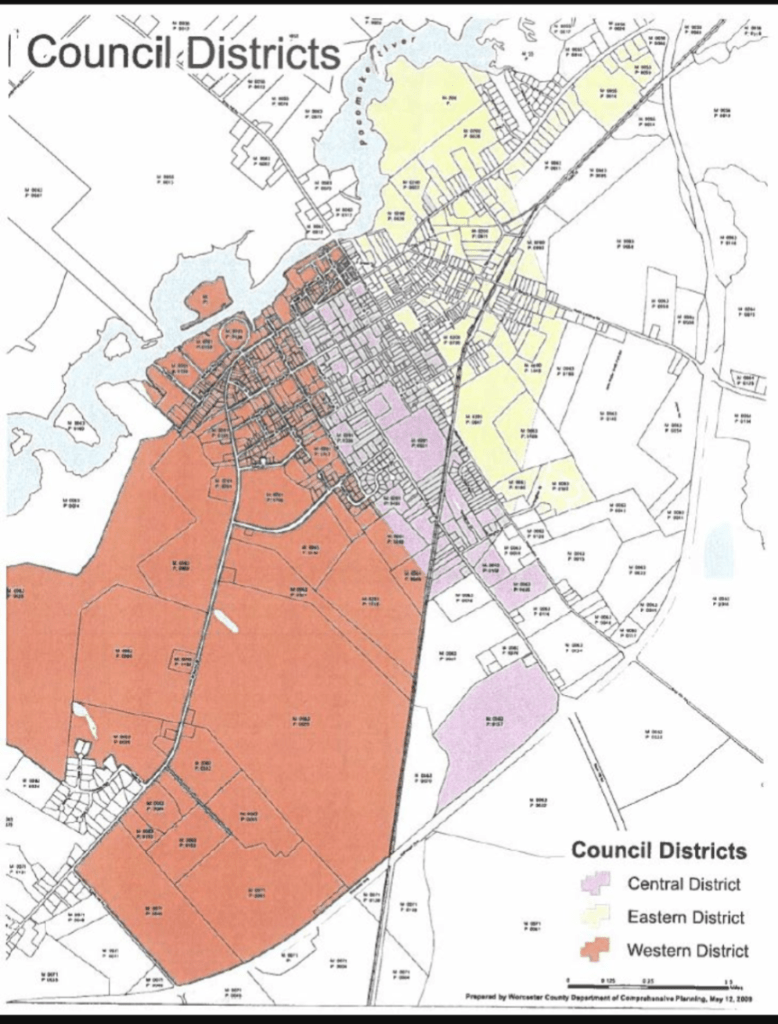
* Snow Hill has three voting districts, each represented by a Council person:
Eastern District – Janet Simpson
Central District – Diana Walsh
Western District – Margaret Ann Fletcher
If you are unsure of the district you live in, you can check the map located here, or call Town Hall to speak with the Town Manager, Rick Pollitt, or Executive Administrator Carol Sullivan.
There is an effort under way through the Charter Review Committee to determine how best to add two additional seats to the Council, possibly adding at least one of the two by the Town elections scheduled for May, 2024, when the Mayor and Eastern District Council seats will be elected. The Charter Review Committee was formed under the previous Mayor (Jennifer Jewell) and Town Council, and is considered an ad-hoc committee, and is currently chaired by Michael Barlow an Assistant State’s Attorney and Town resident.
If you would like to check your voter registration information, please visit the Maryland Voter information portal. Almost everyone with a Maryland driver’s license (and home address) will already be registered, but it is always good to check your registration information at least 30 days before an election.
In Maryland, you must register to vote at least 21 days prior to an election at any level of governance (local, county, state or federal). If you show up to vote and your registration is challenged, you can request to submit a provisional ballot. You have 30 days from the election date to provide evidence of residence and registration at the local Board of Elections for your ballot to be counted.
========
Wastewater Treatment Plant Superintendent Candidate Interviewed & Offered Position
In a special closed session last Monday evening, the Council met with a Candidate for the Wastewater Treatment Plant Superintendent position that has been vacant since mid-summer. After Tuesday night’s meeting, each Council member expressed confidence in the qualifications and commitment of the candidate who was interviewed by Town Manager Rick Pollitt (TM Pollitt) last week. This candidate came recommended by both Director of Maintenance, Randy Barfield, and Greg Smith, who was contracted (over the summer) to address operational and regulatory concerns from an overabundance of septic waste that had been brought to the town’s plant earlier this year.
Over the summer months, Pollitt reported to the Council that this additional waste had overburdened the treatment plant, causing it to malfunction and discharge water that was not within state or federal guidelines. The septic waste has been accepted at the town’s treatment facility for years prior, and fees collected by the septic companies have substantially supported the plant’s operation, given that revenue from Town water and sewer charges were not adequate to do so. Mr. Smith, a state certified and seasoned Plant Superintendent, warned the Council and staff during the summer that the septic effluent, and the more unstable leachate often brought to municipal wastewater treatment facilities, would not continue to be accepted, under his watch, as it posed a significant risk to the plant functioning appropriately. He worked with Director Barfield, and other staff members to clean up the plant and ensure the water being discharged is again well within regulatory limits for toxins and residue.
Mr. Smith also briefed the Council on the difficulty in finding highly qualified Superintendent candidates, noting that the average age of current Superintendents across the country is 58 years, and that there are not enough qualified technicians eligible for certification or to assume the role of Superintendent. In addition Mr. Smith warned the Council and staff that the current pay of $80,000 a year budgeted for the position here in Snow Hill is well below the going rate of $120-150,000 nationwide.
At a previous Council work session, TM Pollitt said that he and the CFO were looking for funds that could be used to increase the Superintendent’s salary in order to entice qualified candidates to apply.
As with many civil service jobs at a local or state level (including police, fire, maintenance professionals and others), there are not enough qualified or interested candidates applying for the large number of vacancies that currently exist. Thus, the field becomes highly competitive, which has pushed salaries for such jobs higher and higher.
Risk Management
The town carries a variety of insurance for both liability and catastrophe, as well as insuring employees for their own health and well-being, and maintaining adequate coverages in the event of a job-related accident. In addition many of the town purchased assets, including police vehicles, maintenance equipment and signage represent a significant investment.
Larry Bohlen, Director of Field Services and Allison Pinkine, Loss Control Consultant, with the Maryland Local Government Insurance Trust (LGIT), provided a comprehensive overview of the Town’s insurance coverages, as well as outlining the Mayor, Council, and town staff’s responsibilities regarding managing the recordkeeping and oversight necessary to ensure the coverage is utilized fully. They also provided insight on how the Town can take full advantage of their membership by requesting a review of practices, procedures and even physical sites with Ms. Pinkine.
The Council will be discussing how to ensure the coverage is utilized, as well as seek to establish an advisory group of employees and possibly citizens to oversee this vital part of the business of managing the town effectively.
Surplus Properties
Peninsula Bank Building and Train Station
Dr. Hogan Pesaniello presented the Council with a plan to rent either the Peninsula Trust building on River Street, or the Train Station, on Bay Street, to operate her therapy practice as well as her miniature zoo she utilizes in her practice. Dr. Pesaniello also noted that the zoo could have a significant cultural impact for visitors, residents and children.
There are a variety of details to work out in order to rent one of the spaces, but the Council expressed a clear interest in doing so under certain conditions. Dr. Pesaniello will meet with TM Pollitt to address the details and draft a lease agreement with the intent of bringing the draft to the Council at the November 30 work session.
Market St. Property
The Council also discussed three lots currently owned along Market Street between Mason Street and West Federal. One lot is zone for residential development, while the second is zoned for high density residential and the last is zoned commercial. One of the lots was donated to the Town by the Scarborough family, ostensibly for building a Police station, but according to TM Pollitt, there is no indication on the recorded deed of that stipulation. However, Mrs. Susan Pruitt, a resident of the area and close friend of Mrs. Netty Scarborough, reminded the Council and staff of Pete Scarborough’s express intentions as well as all the ways the Town utilizes the lots as well as the intent to honor Pete Scaroborough’s memory to ensure the safety of residents and their quiet enjoyment of the adjoining neighborhoods.
Ms. Pruitt also noted that the west end of Market Street has issues with unruly behavior, shootings and vandalism that, in the past, have been tamped down by the added police presence of a satellite station, and simply having police cars parked on the lot.
Police Chief Andy McGee noted that he has plans for a station dated around 2000, but doesn’t know of any other documents outlining plans or intentions to go with them.
Mayor Pruitt commented about there not being funds to build a new police station presently, and suggested that Mr.Pollitt and the Town’s attorney, Maureen Howarth, come up with a plan for how the other two lots could be sold. He also asked if the Scarborough lot could be given back to the family, if they so wish. A plan should be presented to the Council before the end of the year.
Willow Street Property
A property located on Willow Street, directly behind the County District Court building, has sat derelict for just over 20 years after being purchased by the town in 2002. According to local residents, there were residents who lived in the three apartments into the 1990’s. The purpose and intent of the Town’s purchase was not clear, either from discussion at this session or subsequently, but will continue to be researched and investigated for a future post.
There was also a lack of detail in terms of whether the building can be renovated either by the town or a non-profit organization, such as the African American Heritage Society of Snow Hill and Surrounding Area (AAHS). However, in conversations outside of the meeting, it appears that there may be opportunity for the Town to partner with the AAHS and seek, at least, state funding to restore the building as a cultural memorial of the African American community’s contributions to the Town.
The Council Members expressed interest in learning more about the building and its history prior to any action being taken to attempt to sell it. However, Mayor Pruitt offhandedly remarked that the building “ought to be burned down.”
Snow Hill resident Eddie Lee passionately seconded Rob Hall’s comment that the building has significant historical relevance, and should be carefully considered as a landmark, not simply as property to be disposed of.
Martin St. & Pettit Street Lots – Too Small to Build
Two additional lots are owned by the Town, but are not large enough for anything to be built on them. TM Pollitt noted that the neighbors of each lot have been notified that both are available for purchase. The one on Pettit Street has an active contract for sale submitted to the Town, which, Mr. Pollitt said, is scheduled for a first reading during the November 14 Town Council meeting.
Councilwoman Diana Walsh addressed several other properties around town that are under review for code violations and asked if the Town’s Code Enforcement Officer, Marty Sullivan, was planning to attend the Nov. 14 meeting in order to discuss the status and plans moving forward on each. Mr. Pollitt said he would be.
Next Meeting
Town Council meeting scheduled for November 14 at 7:00pm
The agenda for the meeting and related documents are available on the Town’s web site at the link above.
 The Lower Shore Observer